Darryl LeCrue
Hold TightDarryl LeCrue is a special agent who interrogates Mike Baye and helps build the federal case arising from the investigation around Club Jaguar. He is presented through a controlled, physical presence—a pacing interrogator with an unlit cigarette—and through the documents and questions with which he presses Mike. His scenes link the immediate search for Adam Baye to a wider inquiry involving prescriptions, the DEA, and the U.S. Attorney’s Office.
Identity and Introduction
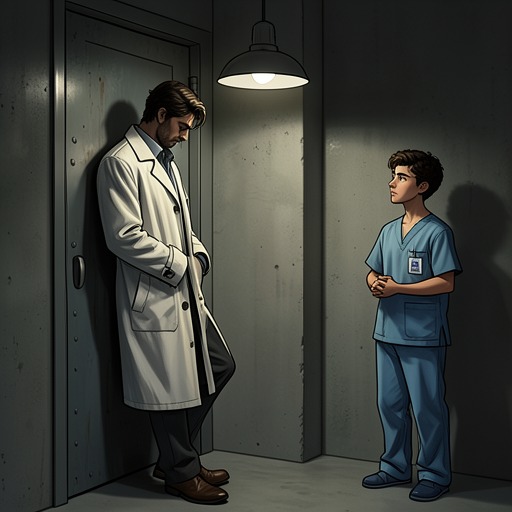
LeCrue first appears in an interrogation room with Mike. Mike assumes the large rectangular mirror on the wall is one-way glass; the remaining setting is starkly institutional, with school-lavatory-green walls and gray linoleum. Two men are present. One sits in a corner with a pen and clipboard, head lowered; the other paces, holding an unlit cigarette. The pacing man is the officer Mike had seen display his badge and gun outside Club Jaguar.
LeCrue identifies himself as a special agent and introduces Scott Duncan as the liaison between the DEA and the U.S. Attorney’s Office. He checks that Mike has been read his rights, then asks whether he is willing to speak. The exchange establishes the formal terms of the interview before LeCrue turns to its substance: Mike is not simply a father looking for his missing son, but also a physician under scrutiny by federal investigators.
The Interrogation of Mike Baye
LeCrue tests Mike’s knowledge of pharm parties, taking care to explain that pharm is spelled with a p-h rather than an f. Mike says the term is not entirely unfamiliar but that he cannot place it. When Mike says he trusts law enforcement but does not believe it sees his son as a priority, LeCrue acknowledges the concern and redirects the conversation to Mike’s medical work, asking whether he is a doctor.
That pivot brings the investigation close to Mike’s professional identity. LeCrue obtains a sheet from a manila folder Duncan hands him, removes it while keeping the unlit cigarette in his mouth, and slides it across the table. The page is a photocopy of a prescription for OxyContin made out to William Brannum. Printed on it are Mike’s and Ilene Goldfarb’s names, their NewYork-Presbyterian address, and their license number. The document gives the interview a concrete focus: the questioning about drug culture is now accompanied by paperwork carrying the physicians’ identifying details.
Evidence, Method, and Stakes
LeCrue’s method in the room combines open questions with a staged presentation of evidence. He first asks Mike to account for what he knows about pharm parties, then introduces the prescription only after Mike has answered questions about his profession. The sequence places Mike’s concern for Adam alongside an investigation that may expose his own credentials to criminal suspicion. LeCrue does not need to announce a conclusion for the photocopy to change the pressure of the exchange; its names, address, license number, and named recipient make the inquiry specific.
The scene also sets LeCrue within a joint federal process rather than a lone interview. Duncan’s stated liaison role connects the DEA and the U.S. Attorney’s Office, while LeCrue conducts the questioning and handles the document. The cooperation between the agents and the prosecutor’s office supplies the institutional frame for the case, even as Mike’s attention remains fixed on whether the authorities will treat his son’s disappearance as urgent.
The Case and Its Later Position
By the final chapter, LeCrue and Duncan have been trying to put the case together. Mike and Adam sit in the same interrogation room where Mike had previously been questioned, but this time they are together and have not answered any questions for hours. Their attorney, Hester Crimstein, refuses to let them speak. Mike understands that investigators have separated people connected with the case—including Rosemary McDevitt, Carson Bledsoe, DJ Huff, and others—in the hope of securing deals and filing charges.
LeCrue’s later significance lies less in a newly described confrontation than in the scale of the investigation he represents. The interrogation that began with a missing son and a question about pharm parties belongs to a broader effort to sort people into witnesses, potential cooperators, and defendants. The return to the same room, now occupied by Mike and Adam together, makes the change in the stakes visible: the inquiry has reached the family whose crisis first brought Mike before LeCrue, while Hester’s refusal to let them answer preserves their silence.